The Aeron Chair is an Ergonomic Masterpiece
The Aeron Chair, made by Herman Miller, is not a beautiful chair in the conventional sense. Nobody sees an Aeron across a crowded room and feels an immediate need to ask for it’s digits. It is black or gray, full of levers, conspicuously devoid of upholstery and covered in mesh like something designed to restrain an unusually sophisticated lobster. And yet…
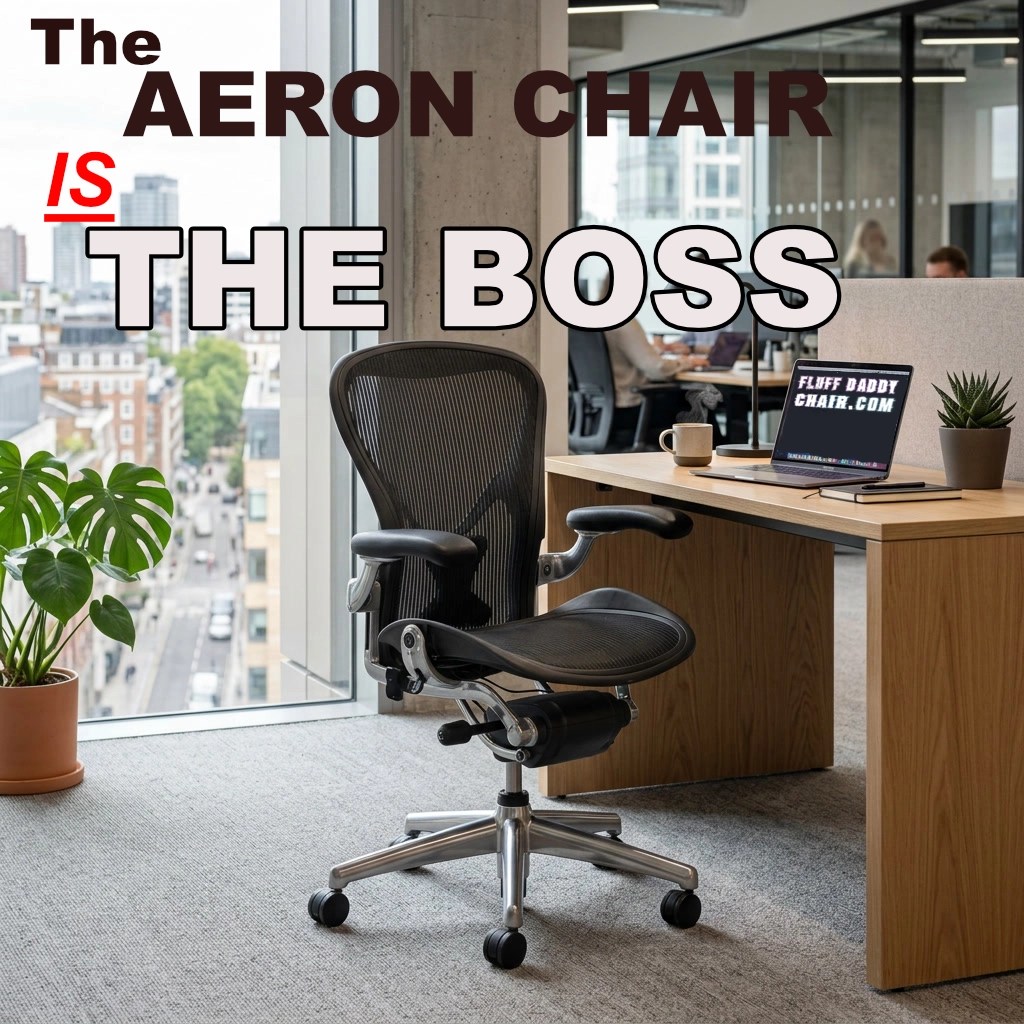
The Aeron Chair Also Happens to be One of the Finest Office Chairs Ever Made.
The Aeron chair’s great achievement is that almost everything odd about it exists for a reason. This is rarer in furniture than you might think. Office-chair manufacturers have spent decades attaching vaguely orthopedic-looking lumps to ordinary chairs and describing the result as “ergonomic.”
The Aeron went much further. Designers Don Chadwick and Bill Stumpf reconsidered what an office chair ought to do when someone sits in it for hours, and the resulting chair, introduced by Herman Miller in 1994, changed what an expensive office chair looked and felt like. Thirty-plus years later, we’re still copying it.
The Mesh Wasn’t There to Look Futuristic
The first thing you notice about an Aeron chair is what isn’t there: cushions. This was a fairly audacious choice in the early 1990s. Expensive executive chairs were supposed to contain enough leather and foam to upholster a Buick. The Aeron instead used a woven suspension material Herman Miller calls Pellicle, stretched across the seat and back. It looks severe. Then you sit down.
The suspension flexes with you instead of requiring your backside to compress several inches of foam before reaching some sort of equilibrium. Your weight is distributed across the seat, and air can circulate through it. Spend a long summer afternoon in an overstuffed office chair and then switch to an Aeron and you’ll discover that “breathability” is not merely something copywriters invented to sell running shoes.
It also avoids one of foam’s less distinguished talents: gradually remembering the precise location of your ass and giving up.
The Aeron Chair Moves Because You Move
The real magic, though, starts when you lean back. Cheap office chairs often treat reclining as a binary event. You’re upright, you push backward, something underneath goes clunk, and suddenly you’re staring at the ceiling wondering whether the warranty covers spinal reconstruction.
The Aeron’s tilt feels integrated with the chair because it was designed around movement rather than around locking a human being into one theoretically correct pose. Depending on the version and adjustments, you can control resistance and limit the tilt, but the underlying pleasure is the same: the chair follows you backward without making the movement feel like a mechanical incident.
That matters because ergonomic sitting isn’t about discovering one perfect position and maintaining it with the discipline of a palace guard. People shift. They lean forward. They recline while thinking. They sit upright to type and then move again five minutes later.
This is a chair that understands that the best sitting position is frequently the next one.
The Adjustments Aren’t Decorative
A fully equipped Aeron has enough controls that your first encounter with one can feel like preflight inspection. Seat height, tilt tension, tilt limiter, arm adjustments and lumbar-support options vary by configuration and generation.
But this isn’t adjustment theater.
The Aeron Chair Size Chart

One of the smartest things about the Aeron is that it comes in three frame sizes—A, B and C—rather than pretending the same chair dimensions will suit every human from a five-foot accountant to an NFL defensive tackle. That’s such an obvious idea that its rarity in office furniture becomes faintly insulting once you notice it.
The armrests can also be positioned so your shoulders aren’t spending eight hours subtly shrugging toward your ears. The back support can be tuned depending on configuration, including Herman Miller’s PostureFit SL system on current models, which supports the sacral and lumbar regions.
None of these things will transform sitting into exercise or absolve you from occasionally standing up. The Aeron is a chair, not Lourdes. What it can do is make prolonged desk work considerably less stupid.
The Aeron’s Hard Edge Is Part of the Bargain
The Aeron chair does have opinions.
This is not a chair that cheerfully accommodates every bizarre way you’ve decided to occupy furniture. If you like sitting cross-legged, tucking one foot underneath yourself or curling into your office chair like a frightened shrimp, the rigid frame around the mesh seat may remind you that this is, technically, an office.
Some people hate that. Fair enough. The Aeron is the anti-papasan. It’s a work chair. Its job is to support a person sitting at a desk while allowing useful movement, not to facilitate the bodily geometry of a Sunday afternoon. That specialization is part of its excellence. Great design sometimes means refusing to be good at everything.
The Aeron Chair Became a Cliché by Being The Best
Of course, the Aeron eventually became a status symbol. During the dot-com boom, startups bought them by the truckload, apparently reasoning that a company without revenue could at least provide excellent lumbar support while collapsing. That association could have killed the chair. Instead, the Aeron outlived the cliché.
You still see decades-old examples in offices and the used market because they’re durable, repairable and worth keeping around. Herman Miller even remastered the Aeron in 2016 rather than replacing it with something fundamentally different. The materials and mechanics evolved, but the basic proposition survived.
A Machine for Sitting
The Aeron isn’t lovable in the way a battered leather armchair is lovable. It doesn’t invite you to curl up with a novel, and nobody will inherit Grandpa’s Aeron and become emotional about the coffee stain on the armrest. Its excellence is colder and more impressive than that.
The Aeron is a tool that has been unusually well resolved. The mesh supports without smothering you. The chair moves instead of merely reclining. The adjustments correspond to actual differences between bodies. The different sizes acknowledge that humans inconveniently refuse to come in “one size fits all.”
Most importantly, after you’ve adjusted a good Aeron properly and worked in it for a while, the chair begins to disappear. You stop negotiating with it. You stop shifting because some piece of foam has collapsed or an armrest is fighting your elbow. You simply sit, move and work. That’s the paradox of spending serious money on an office chair: the better it gets, the less you think about it.
The Aeron has spent more than three decades being imitated, mocked, fetishized, resold, refurbished and parked behind the desks of everyone from CEOs to programmers wearing T-shirts older than their interns. Underneath all that cultural baggage is the reason it survived. It’s a hell of a chair.
A Little-Known Fact About the Aeron Chair
When designers Bill Stumpf and Don Chadwick began the project that became the Aeron, Herman Miller was exploring seating for older people, particularly a chair that would be comfortable for long periods without the heat buildup and pressure problems associated with thick foam upholstery.
That helps explain several things that later made the Aeron seem startlingly futuristic. The designers abandoned the conventional foam-and-fabric seat in favor of a suspended woven material—the ancestor of Aeron’s famous Pellicle mesh—and paid unusual attention to pressure distribution, movement and different body sizes.
The project eventually migrated from residential/elder seating toward the workplace, and when the Aeron appeared in 1994, it looked almost perversely wrong for an executive office. There was no leather. No thick padding. No mahogany-adjacent gravitas. It looked like the chair had arrived before someone finished upholstering it.
Then came the particularly funny part: the Aeron initially tested poorly in some market research because people didn’t think it looked comfortable. Consumers had learned that expensive comfort meant padding, and the Aeron had basically none.
So one of history’s most famous ergonomic office chairs emerged partly from thinking about the needs of aging bodies—and then had to overcome people’s suspicion that a chair without a giant cushion couldn’t possibly be comfortable.
The Aeron didn’t merely improve the office chair. It helped teach people what an ergonomic chair was supposed to look like.
Aeron Chair FAQs
For people who spend most of the workday sitting, it can be. You’re paying for excellent ergonomics, adjustability, durable construction and replaceable parts—not Italian leather and executive-room theater.
Often well over a decade with reasonable care, and much longer examples are common. Parts such as casters, arm pads and lumbar supports can also be replaced. The Aeron has made the used-office-furniture business unusually happy.
Aeron comes in A, B and C sizes, roughly corresponding to smaller, medium and larger users. See the above Aeron chair size chart to find the best fit for you.
It provides adjustable ergonomic support that many people find comfortable, but it isn’t a treatment for back pain. Proper sizing and adjustment matter enormously. A $1,500 chair adjusted badly is still a badly adjusted chair.
You can, but it isn’t particularly good for it. The rigid frame surrounding the mesh seat makes tucked-leg and cross-legged positions less comfortable than on a broad cushioned chair. The Aeron expects you to behave like you’re at work.
The Remastered Aeron, introduced in 2016, updated the tilt mechanism, suspension, adjustment controls and available back support while retaining the basic Aeron concept. The Classic remains an excellent chair and is abundant on the used market.
Herman Miller’s standard Aeron does not include a headrest. Aftermarket headrests are available, but the chair was designed to support an active range of seated positions without one. Apparently your head is expected to handle some responsibilities itself.
